
The Golden Rule of Telematics Storage
Whether you choose a card or a drive, avoid consumer-grade hardware. Standard SSDs and SD cards use TLC (Triple-Level Cell) memory designed for occasional use. In a telematics environment, these cells burn out in months. Always look for “High Endurance,” “Industrial,” or “Automotive” labels. These use MLC or specialized 3D NAND that can be overwritten thousands of times without failing.
Pro Tip: For SSD-based systems, ensure your housing is ventilated. Even industrial SSDs generate significant heat when writing multiple streams simultaneously.
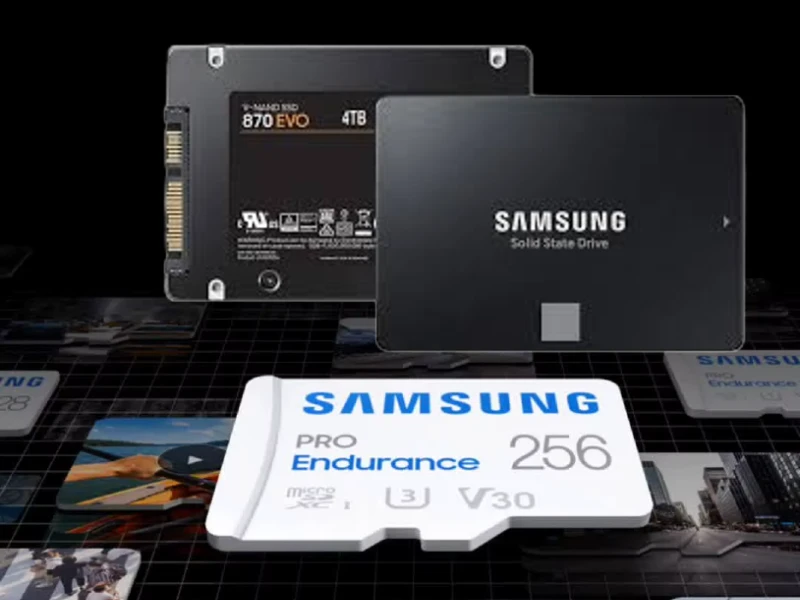
The microSD Gold Standard: Samsung PRO Endurance
For standard dash cams and compact telematics units, the Samsung PRO Endurance remains the king of the “set it and forget it” category.
Why it’s a top pick:
- Insane Lifespan: The 256GB model is rated for up to 140,160 hours of continuous recording. That is over 16 years of nonstop video—roughly 4x longer than standard “Extreme” cards.
- Environmental Shield: It is built to survive the “oven” effect of a parked car, with operating temperatures ranging from -25°C to 85°C.
- Wear-Leveling Logic: Samsung’s controller is specifically tuned for constant loop recording, preventing “dead spots” on the card that cause file corruption.
Best For: Long-haul trucking and personal dash cams that require 24/7 reliability in a tiny form factor.
The High-Endurance Value: Samsung 870 EVO (with a Caveat)
In the demanding world of video telematics, the “standard” SSD you buy for a home office just won’t cut it. Between 24/7 write cycles, extreme cabin temperatures, and constant road vibration, telematics hardware is a graveyard for cheap storage.
The Samsung 870 EVO is the best “accessible” choice for telematics, provided you over-provision the capacity.
Why it wins:
- Proven Controller Reliability: The MKX controller inside the 870 EVO is famous for its stability. In telematics, “predictable” is better than “fast,” and this drive handles sustained writes without the stuttering found in budget brands.
- Superior TBW (Total Bytes Written): The 4TB model offers a massive 2,400 TBW rating. By using a higher capacity drive than you think you need, you spread the “wear” across more NAND cells, effectively turning a consumer drive into a long-term telematics solution.
- Broad Compatibility: Because it adheres strictly to SATA standards, it works with almost every 2.5-inch black box or mobile DVR on the market.
Best for: Multi-camera dash cam setups and owner-operators who need a reliable, high-capacity drive without the “Industrial” price tag.